Showing Islam is Peaceful • Tolerant • Rational • Inspiring
| Home
|
| 1.
Islam |
2.
Ahmadiyya Movement Maulana Muhammad Ali Reviews of Bayan-ul-Quran  |
| 3.
Publications & Resources |
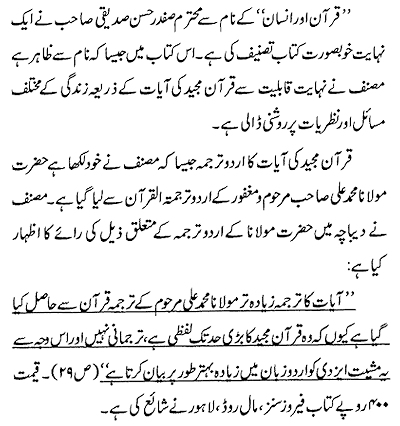
Reviews of Bayan-ul-QuranThis is Urdu translation of the Holy Quran with extensive commentary by Maulana Muhammad Ali (including Arabic text). The commentary is about twice as long as in the English work. 1. In the Urdu book Quran aur Insan, which quotes verses of the Holy Quran dealing with various problems and aspects of human life, the author Safdar Hasan Siddiqi writes in the Preface: “I have taken the translation of the verses of the Holy Quran mostly from the translation by the late Maulana Muhammad Ali because it is, to a great extent, a translation of the words and not his own interpretation, and for this reason it expresses the Divine will in the Urdu language in a better way.” Details of the Review shown below in Urdu:
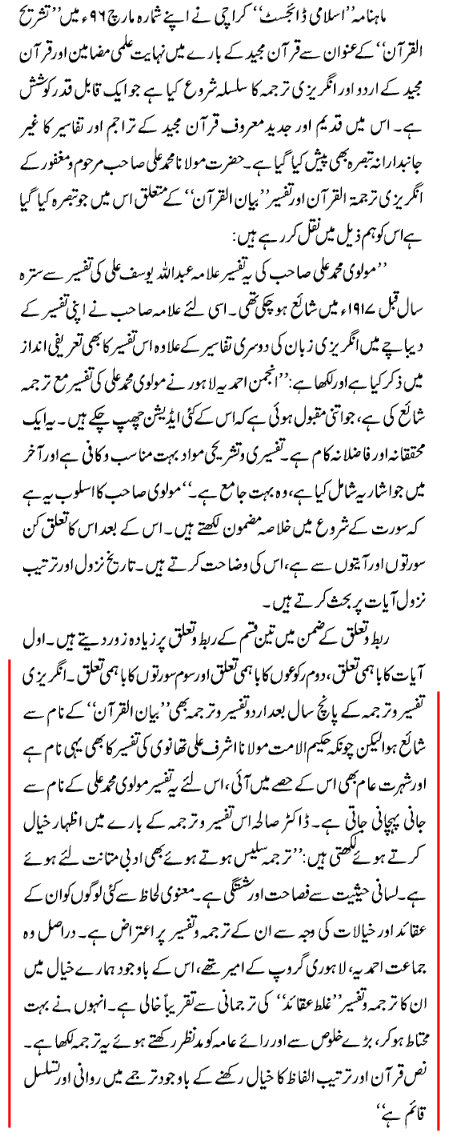
2. The Urdu monthly Islami Digest of Karachi (editor: Syed Qasim Mahmud) in its March 1996 issue opened a series entitled Tashrih-ul-Quran. Its review of Maulana Muhammad Ali’s English translation has already been quoted in the last chapter. Regarding Bayan-ul-Quran it says: “Five years after his English translation and commentary the Urdu translation and commentary was published, having the title Bayan-ul-Quran. … Expressing her view about this work Dr. Saliha writes:‘The translation, while being simple, has literary weight. The language is eloquent and chaste. As to the meaning, some people have objections against his translation and commentary because of his beliefs and views. The fact is that he was the head of the Lahore Ahmadiyya Jama‘at. Despite this, we consider that his translation and commentary is almost free of ‘wrong beliefs’. He has done the translation very cautiously, with great sincerity, and having kept before him the generally prevailing views. Despite closely following the text and the order of the original words, the translation has continuity and flow.’ ” Details of the Review shown below in Urdu: The part which is translated above in English is marked by red lines below. The first part of the Urdu below, which we have not translated, relates to Maulana Muhammad Ali’s English translation of the Quran.
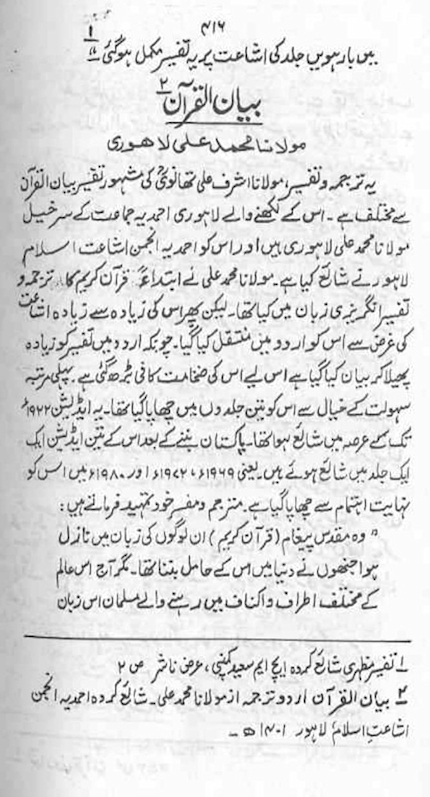
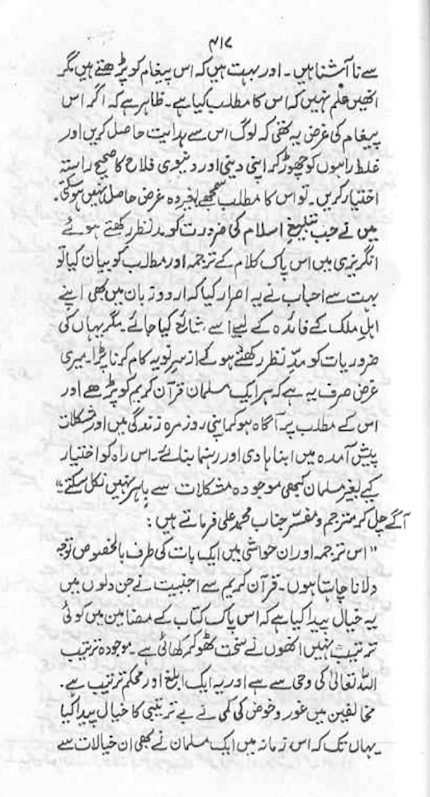
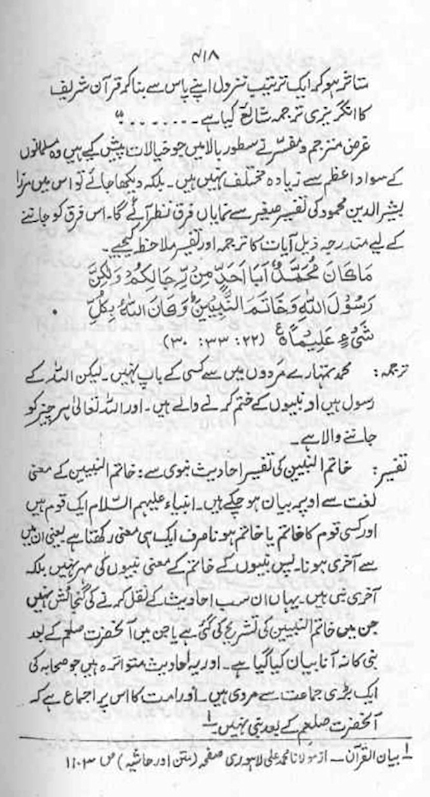
3. Professor Dr. Muhammad Nasim Usmani in his book Urdu Main Tafsiri Adab: Aik Tarikhi aur Tajziyati Ja’iza (‘Quranic Commentaries in Urdu: A Historical and Critical Analysis’, published Karachi, 1994) writes on pages 416 to 418: “This translation and commentary is different from the famous commentary Bayan-ul-Quran by Maulana Ashraf Ali Thanvi. Its author is the Head of the Lahore Ahmadiyya Jama‘at, Maulana Muhammad Ali of Lahore, and it was published by the Ahmadiyya Anjuman Isha‘at Islam Lahore. Maulana Muhammad Ali first produced a translation and commentary of the Holy Quran in English, and then, to make it more widely available, he rendered it into Urdu. As the commentary in Urdu is more comprehensive, the size of the book increased considerably. So for convenience it was first published in three volumes, around the year 1922. Since Pakistan came into being, three editions have been published which were in one volume, in 1969, 1972 and 1980.” He then gives two quotations from the Maulana’s Preface, in the first of which the Maulana has stressed the need for Muslims to understand the Quran, and in the second the Maulana has refuted the notion that the Quran does not have a systematic arrangement of subject matter. After citing these quotations, the reviewer makes the following comment: “The views that the translator has expressed in these lines are not very different from what the vast majority of Muslims believe. In fact, this commentary is clearly different from the Tafsir Saghir of Mirza Bashir-ud-Din Mahmud Ahmad. To see this difference, look at the translation and commentary of the following verses.” He quotes as his example the translation and explanation of the ‘finality of prophethood’ verse (33:40) from Bayan-ul-Quran. Scans of pages from the original book by Professor Dr. Muhammad Nasim Usmani:
4. In the Urdu journal Fikr-o-Nazar, published by the Islamic Research Institute, International Islamic University, Islamabad, Pakistan, there is a lengthy article by Muhammad Arshad entitled Bar-i Saghir mein tafsir-i Quran ka kalami usloob or ‘Styles of exegesis of the Quran in the Indian subcontinent’ (vol. 41, no. 3, 2004, pages 13–17). On pages 20–21 it reviews Bayan-ul-Quran by Maulana Muhammad Ali. At this link we provide pages 20–21 extracted from the pdf version of the full article. For clarity, we have indicated the section relating to Bayan-ul-Quran by a red marginal line, and have obscured the text occurring before and after this section. Since the whole article refers to many endnotes, we have also added those endnote pages (54–55) which carry the notes referred to in the section on Bayan-ul-Quran. The pdf of the whole article is at this external link. |
 Top
Top