Read Correction
of an Error, the translation of Ayk
Ghalati Ka Izala in book form, with explanatory notes and a detailed study.
What the Qadiani Jama‘at
believes about
Ayk Ghalati Ka Izala
In any discussion of the booklet Ayk Ghalati Ka Izala it is
important to bear in mind what the Qadiani Jama‘at believes
about it and what significance they attach to it.
The Qadiani Jama‘at belief is that it was by the
publication of this booklet, in November 1901, that Hazrat Mirza
Ghulam Ahmad first announced to the world that he was claiming to
be a prophet.
Both the Qadiani Jama‘at and the Lahore Ahmadis
agree that Hazrat Mirza Ghulam Ahmad laid claim to be the Promised
Messiah in 1891. They also agree that, having made that claim, he
denied and kept on denying that he was claiming to be a prophet,
and wrote again and again that his claim was that of a muhaddas
(a non-prophet who receives revelation from Allah) and mujaddid.
The difference is that the Qadiani Jama‘at believes
that after about ten years he changed his position and declared
to the world in Ayk Ghalati Ka Izala that he was in fact
a prophet. But the Lahore Ahmadis believe that his position never
changed, and remained the same as it was in 1891 to the very end
of his life.
To show that the Qadiani Jama‘at does indeed hold
this belief, we quote below from the book Haqiqat-un-Nubuwwat
by Mirza Bashir-ud-Din Mahmud Ahmad, their second Khalifa, published
in March 1915:
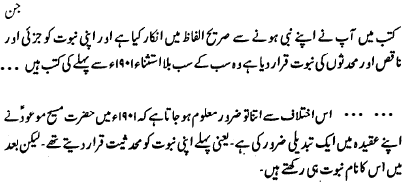
- “The books in which he has denied being a prophet in clear
words, and has called his prophethood as partial and imperfect,
and as the prophethood of saints (muhaddas), are all without
exception books from before the year 1901 … It is definitely
found that in 1901 the Promised Messiah certainly made a change
in his belief, that is to say, previously he considered his prophethood
as being sainthood (muhaddas) but afterwards he only called
it prophethood.” — p. 120.
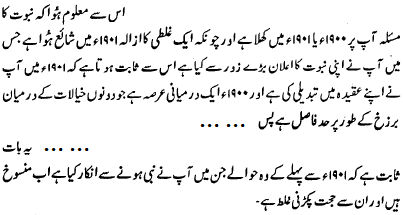
- “The issue of prophethood became
clear to him in 1900 or 1901, and as Ayk Ghalati Ka Izala
was published in 1901, in which he has proclaimed his prophethood
most forcefully, it shows that he made a change in his belief
in 1901, and the year 1900 is a middle period which is like a
boundary between the two views. … It is proved that the references
dating prior to the year 1901 in which he has denied being a prophet,
are now abrogated and it is an error to use them as evidence.”
— p. 121.
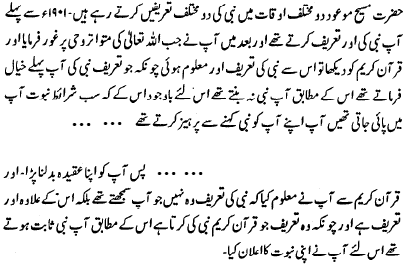
- “The Promised Messiah during two
different periods defined ‘prophet’ in two different
ways. Before the year 1901 he used one definition of ‘prophet’.
Afterwards, by pondering on his continuous revelation from God
and by examining the Holy Quran, he discovered a different definition
of ‘prophet’. According to the previous definition of
‘prophet’ in his mind, he was not a prophet, and therefore
while all the characteristics of prophethood were found in him,
he refrained from calling himself a prophet. … Thus afterwards
he had to change his belief. He discovered from the Holy Quran
that the definition of ‘prophet’ was different from
what he had thought, and as according to the definition of ‘prophet’
in the Quran he was proved to be a prophet, therefore he declared
his prophethood” — p. 122
- “The first evidence of the change
in this belief is found in the announcement Ayk Ghalati Ka
Izala, which is the first written evidence.” — p.
124.
According to the Qadiani Jama‘at belief expressed
in these extracts, Hazrat Mirza Ghulam Ahmad, having become the
Promised Messiah in 1891, did not know what makes a man into a prophet.
Therefore, while being a prophet he did not consider or call himself
a prophet; indeed he denied being a prophet. This state of affairs,
according to the Qadiani Jama‘at belief, lasted for
some ten years. In the year 1901, they assert, he discovered the
right definition of a prophet, and realized that he had been a prophet
all along, and so he wrote Ayk Ghalati Ka Izala to announce
that he was a prophet.
The question to be determined is, therefore:
- Has Hazrat Mirza Ghulam Ahmad changed his belief in this booklet
as claimed by the Qadiani Jama‘at,
- or has he reaffirmed the beliefs he expressed previously as
claimed by the Lahore Ahmadis?
It is not sufficient for the Qadiani Jama‘at just to
point out that Hazrat Mirza has called himself a prophet in this booklet,
because they agree that he had been using this word for the past ten
years but in a metaphorical sense and without claiming to be a
prophet. What the Qadiani Jama‘at must show is that
in this booklet Hazrat Mirza made a change in his belief from
his previous position, and they must prove their contentions that:
- He now “discovered a different definition of ‘prophet’ ”,
according to which he was a prophet.
- His previous denials of prophethood “are now abrogated”.
- This booklet is “the first evidence of the change in his
belief”.
Contradiction
In his book Haqiqat-un-Nubuwwat quoted above, Mirza Mahmud
Ahmad goes on to summarise his standpoint as follows:
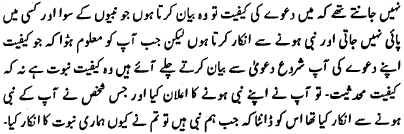
- “He [the Promised Messiah] did not know that
the nature of the claim he was putting forward was that of a claim
that only prophets can make, and no one else, and yet he was denying
being a prophet. But when he discovered that the nature of his
claim that he had been putting forward since the beginning of
his claim was that of prophethood and not sainthood, he declared
himself as a prophet, and he rebuked the follower who had denied
his being a prophet, telling him: as I am a prophet why did you
deny my prophethood.” — p. 124
Mirza Mahmud Ahmad says that the Promised Messiah declared in Ayk
Ghalati Ka Izala for the first time that he was a prophet
and that he had up to that time been wrong in denying claiming
to be a prophet. Yet he also says that, in the same Ayk Ghalati
Ka Izala, the Promised Messiah rebuked his follower
for denying that he claimed to be a prophet! The earlier error
in putting forward the claim was, according to Mirza Mahmud Ahmad,
made by the Promised Messiah and yet he rebuked his follower for
making that mistake!
Urdu original texts for reference
Given below are the Urdu texts of the above quotations from Mirza
Mahmud Ahmad’s book Haqiqat-un-Nubuwwat. This book
is available for reading on the Qadiani Jama‘at website
within the volumes of a collection entitled Anwar-ul-‘ulum
at the link: http://www.alislam.org/urdu/au/. This book is volume
2, book number 10, of that collection. Page numbers below refer
to this volume.
Quotation 1 (p. 443–444):
Quotation 2 (p. 444-445):
Quotation 3 (p. 445–446):
Quotation 4 (p. 447):

Quotation 5 (p. 448):
|


 Top
Top